


The theme of this year’s World Digital Preservation Day is Why Preserve?
For the archives of humanitarianism (where I work, as the Humanitarian Archivist at the University of Manchester Library) this question is very relevant. Over the past 20-30 years archives produced by humanitarians have become critically endangered. Ever since the shift to digital working, humanitarians have struggled to keep track of their ever expanding, ever changing digital records, which, after only a few decades, has already affected their survival. This has been recently accelerated by international cuts to humanitarian funding, most notably the effective closure of USAID, and even the larger institutions are having to make drastic cuts to their operations, including to their archives.
But why should we preserve these digital humanitarian archives in the first place? Humanitarians in the field hardly have time to even create records and often using instant messaging, like WhatsApp or Telegram to quickly send information or discuss work with their colleagues. Why then, should people who are providing care in conflict and disaster situations take time to look after their digital records? Why take the effort to try and save these fleeting digital records, which are often designed not to be kept?
Throughout the 20th century, humanitarians have been at the forefront of the disasters and conflict zones that have shaped the modern world. Their perspective is unique from that of other similar parties, such as the military, or politicians, in that it shows how these events affect the lives of people on the ground, and how humanitarians try (with varying levels of success and failure) to fix them. Their archives show how the world treats the most vulnerable populations, reflecting the neglect and cruelty that causes this suffering but also care that tries to alleviate it. As conflict, violence, and disasters become increasingly common, humanitarian work is more present and needed than ever, and their archives are evidence of the range of situations and people that they work with. The survival of archives from a broad range of humanitarian actors also represents the aid, medical and educational work that happens throughout the world, the people who carry it out and how it has evolved over the years. This makes these archives a crucial resource for humanitarians themselves, to be able to reflect on their past successes and failures which can in turn inform and improve their current practice.
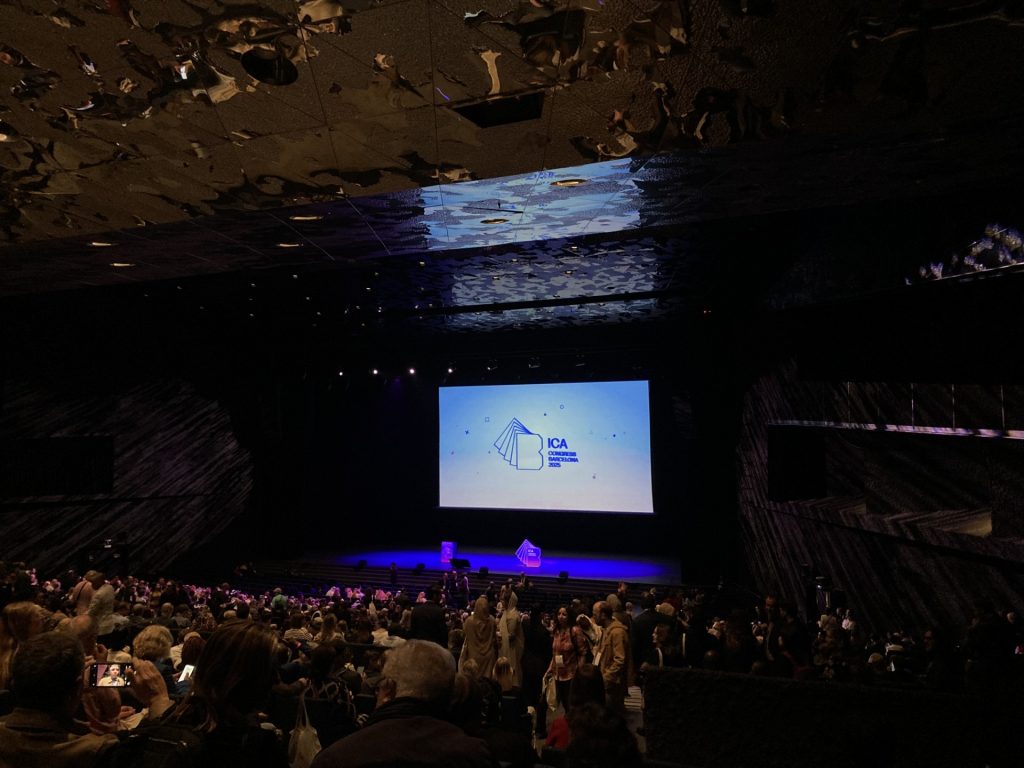
ICA Congress Barcelona opening ceremony.
I recently attended the International Council on Archives (ICA) Congress in Barcelona. This congress, held every four years, is a chance for professionals from across the world to meet and discuss issues relevant to archives today. Throughout the panels and discussions this year, there was awareness of the rapidly multiplying threats to archives and the work of preserving them. Climate change, conflict, political repression, funding cuts and rapid technological shifts are all coalescing to create an environment of austerity and instability that is not likely to be alleviated soon, and which archivists have no power to control. How then can our sector adapt to preserving the growing mass of digital information that is becoming archives, often without adequate resources and in precarious or even dangerous environments?
Many presentations discussed, directly and indirectly, potential ways to tackle these threats, and how the core archival principles, which were developed more than a century ago to manage a much smaller volume of paper archives, need to adapt. These included creating coalitions to support countries where archives are targeted for destruction, using AI to help assess and triage huge amounts of digital information, and creating archival guides for non-archivists to help them manage their own documentation for cultural and advocacy purposes.
In a similar vein, the Humanitarian and Conflict Response Institute (HCRI) and the University Library at the University of Manchester have recently launched a project to address the now urgent shortfall in humanitarian archives. The Humanitarian Archive Emergency project will embark on a comprehensive scoping exercise of at-risk archives, records, and datasets, and it will also develop a crowdsourcing tool to help identify and help find a recovery solution for at risk information.
All of this work, both at Manchester and across the world has, and will, take a great deal of resources and effort, and there will be new obstacles in the future that we will again have to adapt to. Despite this, the question of why we do it is also easy to answer. The possible extinction of the records of our world, within the humanitarian sphere and beyond, is something that motivates many people – archivists, researchers, digital preservationists and others – to find new methods and partnerships to ensure their continued survival.