

We are excited to launch a new workpackage within the Developing Humanitarian Medicine (DHM) project, exploring the history and development of Emergency Medical Teams (EMTs) and the WHO’s EMT Initiative. This workpackage will interrogate various themes related to EMTs and the history of humanitarian medicine, including the development of norms, standards and coordination mechanisms, and the shifting role of NGOs, states and state sovereignty.
Recent decades have seen growing numbers of emergency medical teams responding to crises and conflicts worldwide. In the 1990s and 2000s, concerns about a lack of accountability, poor coordination and inconsistent quality of care led to calls for better regulation, particularly in the wake of responses to specific, high-profile crises, such as the 2004 Indian Ocean tsunami, earthquakes in Iran in 2003 and Pakistan in 2005, and floods in Pakistan in 2010. The 2010 earthquake in Haiti, which saw the deployment of more than 300 emergency medical teams, is often identified as a particular turning point, lending momentum to calls for better regulation. Research identified major shortcomings in the response to the earthquake, with medical relief taking the form of “a wild market rather than coordinated help”.
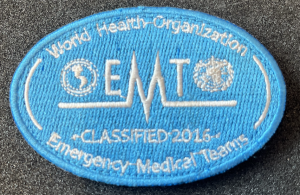
EMT badge (2016), Tony Redmond Collection, University of Manchester library
In December 2010, a meeting was convened in Cuba to discuss the registration and accreditation of what were then termed Foreign Medical Teams (FMTs), leading to the establishment of a working group. This was followed in 2013 by the publication of the ‘Classification and Minimum Standards for Foreign Medical Teams in Sudden Onset Disasters’, or the “Blue Book” (which HCRI, the home of the DHM project, played a role in developing). The classification system was first used in the response to Typhoon Haiyan in the Philippines in 2013, when just over half of arriving FMTs registered using the new system. A change in terminology from ‘foreign medical teams’ to ‘emergency medical teams’ followed in December 2015, in recognition of the “importance of national and international teams working collaboratively”.
Over the last decade, EMTs have expanded in number, scope and scale. As of September 2025, there were 60 WHO-classified EMTs worldwide, including 40 governmental teams (both civilian and military) and 20 non-governmental, with many more working towards classification. EMTs are now described as “an essential part of the global health workforce, particularly during times of acute crises”, with the Blue Book “fast becoming an international norm (much like the Sphere standards)”. They also form a core pillar of the nascent Global Health Emergency Corps. While originally focused on responding to sudden-onset disasters, EMTs increasingly operate in conflict settings and complex emergencies, and have deployed in response to disease outbreaks and epidemics. In 2021, the WHO published the “Red Book”, containing guidance and additional verification requirements for EMTs responding to health emergencies in armed conflicts, followed in 2024 by guidance and standards on responding to infectious disease outbreaks.
Despite their clear and growing importance, academic research on EMTs remains relatively limited. Existing literature primarily takes the form of case studies and reports from specific deployments, with broader anthropological and historical analysis sparse. This research therefore seeks to understand the wider history and development of EMTs, exploring the processes and events through which they have taken shape, and the actors and organisations involved. What is the position of EMTs in the history of humanitarian medicine, understood not just as medical interventions in humanitarian settings, but as the delineation of particular “ways of doing and ways of knowing”? What role do they play in setting and shaping norms and standards, and in defining the reach and remit of humanitarian medicine? And, crucially, how do they fit into a rapidly changing humanitarian landscape, in the context of sweeping cuts to humanitarian and global health budgets, growing attacks on healthcare during conflict, and increasing denials of access?
Drawing on oral history interviews with individuals involved in shaping individual EMTs and the wider EMT Initiative, the research will help foster a deeper understanding of the history and development of EMTs. We are interested in hearing about the lives and careers of individuals involved in EMTs in a range of capacities. Through these interviews, the workpackage will contribute to the University of Manchester’s Humanitarian Archive, which includes an expanding collection of oral history recordings in which humanitarians discuss and reflect on their life and work.
We will also be drawing on materials held in the Humanitarian Archive, such as the Tony Redmond Collection, providing insights into past humanitarian medical missions and the establishment of EMTs.
If you’d like to hear more, have any questions, or are interested in participating in the research, please contact Dr. Alice Robinson at alice.robinson-2@manchester.ac.uk.